
If you’re thinking about a major renovation, one of the first questions you’re likely to ask is: “How much will it cost?”
Many of the homeowners we initially speak to expect to hear a cost per square metre, and they may have already been given that by other builders.
Below we explain why we strongly advise against relying on this to determine what your renovation will actually cost, taking you through why two renovations with exactly the same floor area can have very different costs.
Why Square Metre Cost Can Be Misleading
Imagine two homeowners are both planning a 60m² second-storey addition.
One house might have good access, a straightforward roof structure and a layout that requires relatively little alteration to the existing home.
The other might require significant structural work, modifications to the existing roof, changes to the ground floor and extensive alterations to plumbing and electrical services.
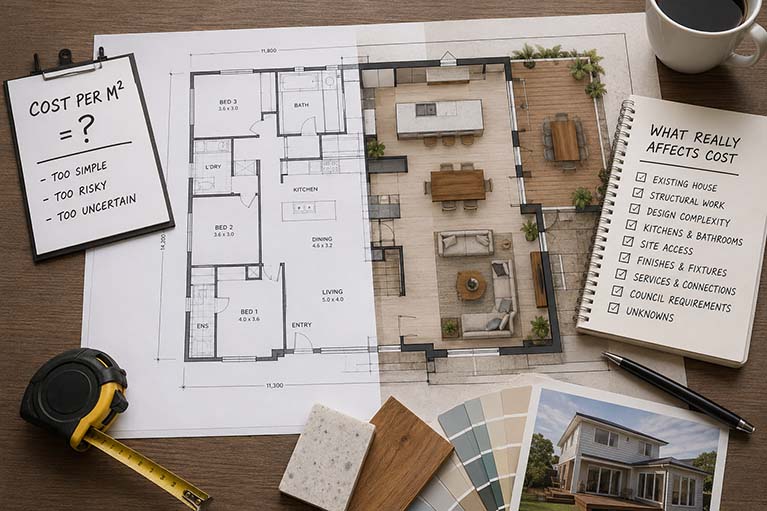
With both projects, the extra space required is 60 square metres, but they could have very different construction costs taking into account the following factors:
- The condition and construction of the existing house
- Structural requirements
- The complexity of the design
- Site access and construction conditions
- Number of new kitchens and bathrooms vs other rooms
- Changes to existing rooms and services
- The work required to connect the new and existing parts of the house
- Windows, doors, joinery and other fittings
- The level of finishes and materials you choose
Many of the above are particularly relevant to a major renovation because you’re not simply building a new space. You’re modifying an existing building, and the relationship between the old and new parts of the house can have a major impact on the cost.
Plus additions, extensions and major renovations often have higher proportions of the more expensive room types (in terms of cost per square metre) like kitchens and bathrooms than new home constructions.
The Problem of Incomplete Information
At the early stages of a renovation, many things may not yet be known. The design may only be conceptual. The existing structure may not have been assessed. Engineering may not have been completed. Materials and finishes may not have been selected.
A builder can still give you a number at this stage, but it’s important to understand what that number represents.
It may be a preliminary estimate based on assumptions rather than a reliable indication of what the completed renovation will cost.
As the project develops, those unknowns become known. Engineering is completed. The design becomes more detailed. The existing building is investigated. Specifications are selected.
And costs that weren’t apparent at the beginning can start appearing in the budget.
Appraising Estimates
Suppose three builders give you preliminary estimates of $450,000, $500,000 and $550,000.
It might seem obvious that the first builder is offering the best deal. However, before comparing the numbers, you need to understand what each estimate is actually based on.
Does each one include the same structural work? The same level of finishes? Demolition? Scaffolding? Waste removal? Plumbing and electrical modifications? Professional costs? Site requirements?
What assumptions have been made? And what has been excluded because it isn’t yet known?
If one estimate contains more assumptions or exclusions than another, you’re not necessarily comparing like with like.
A low initial estimate doesn’t always mean that the renovation will ultimately cost less. It may simply mean that less of the project has been properly defined at that point.
Reducing the Number of Unknowns
The solution isn’t to demand a cost per square metre before the project has been properly investigated, the aim should be to reduce the number of unknowns before you make major financial decisions.
A proper assessment of your renovation should consider the existing house, what you’re proposing to change, the structural requirements, the complexity of the work, site conditions and your expectations for finishes and fittings.
It should also identify what still needs to be investigated.
The result won’t necessarily be a price that can never change. No one can predict every issue that might be uncovered during a renovation.
But the more information you have, the more meaningful the pricing becomes.
Start with a Proper Assessment
This is one of the reasons it can be worthwhile speaking to an experienced renovation professional before committing to a builder or relying on a rough cost per square metre calculation.
At Addbuild, the process starts with an obligation-free design consultation at your home.
One of our experienced Design Consultants meets with you to discuss what you want to achieve, consider any other alterations you’d like to make to your existing home, discuss your budget and measure the existing house.
From there, Addbuild can prepare a Design Proposal at no cost and with no obligation, including design sketches, a detailed specification of materials and scope of works, and a preliminary estimate for the project.
The important point isn’t simply that you receive a number.
It’s that the number is developed in the context of your house and your proposed renovation, rather than simply applying a generic rate to the number of square metres you’re adding.
If you proceed, the next stage involves more detailed investigation, including building plans, structural engineering and a site survey. These are then used to establish a fixed building price.
In Summary
A major renovation isn’t a commodity that can be accurately priced by multiplying the floor area by a standard rate. The existing house, design, structure, site, specifications and countless other details all contribute to the final cost.
So instead of asking only:
“How much does a renovation cost per square metre?”
ask:
“What will my particular renovation involve, and what information do we need before we can establish a realistic budget?”
The more you know about the project before you start comparing prices, the better placed you are to make a sound decision.
A reliable renovation budget starts with reliable information. An experienced builder should take you through a process where they ask you the right questions to narrow the information gap as much as possible at every stage.
Looking to Renovate Your Home?
If you are getting serious about a major renovation and need to work out a realistic costing, we’d love to help you. Addbuild has unbeatable experience and know-how based on over 2,000 renovations, additions and extensions, all in the Sydney area.
Our Design Consultants work with you closely to plan the extra space you need, guiding you with the right advice and asking the important questions so that your project and budget have the correct foundations.
With Addbuild, you make important decisions about your renovation based on accurate costs and prior to committing to spending large amounts of money based on what can only be described at best as a “guesstimate”.
And as a ‘concept-to-completion’ contractor, we don’t only build additions and extensions, we design and handle the development application process on your behalf, saving you time and money.
Call our office on (02) 8765 1555 or send us a message using our contact form if outside of office hours.
Looking for inspiration? See our feature projects and ‘before and after’ photos.
If you are still researching, have a look at our blog, consumer guide to home improvement and masterclass to get further ideas about every aspect of renovating your home.